Hardwood Basketball Flooring: Maple, Birch or Engineered?
Hardwood basketball flooring is often treated as a single product category, but the finished court depends on far more than the visible wood species. Maple, birch and engineered multi-layer boards can each be used in sports environments, yet their stability, grading, moisture behavior, repair methods and system designs differ. The sleeper or keel structure, resilient pads, finish and environmental controls are just as important as the surface board.
The correct choice therefore starts with the venue. A professional arena, school gym, humid coastal sports hall and portable event court may all require different constructions. This guide compares the main options without assuming that the most expensive surface is automatically the best project solution.
| Quick answer: Maple is the traditional premium choice for many indoor basketball courts because of its light appearance, established grading and sports-floor history. Birch can provide a different visual and commercial balance. Engineered multi-layer wood can improve dimensional stability and material efficiency. In every case, performance depends on the complete subfloor system, environmental control, finish and installation quality. |
The Surface Species Is Only One Part of the Court
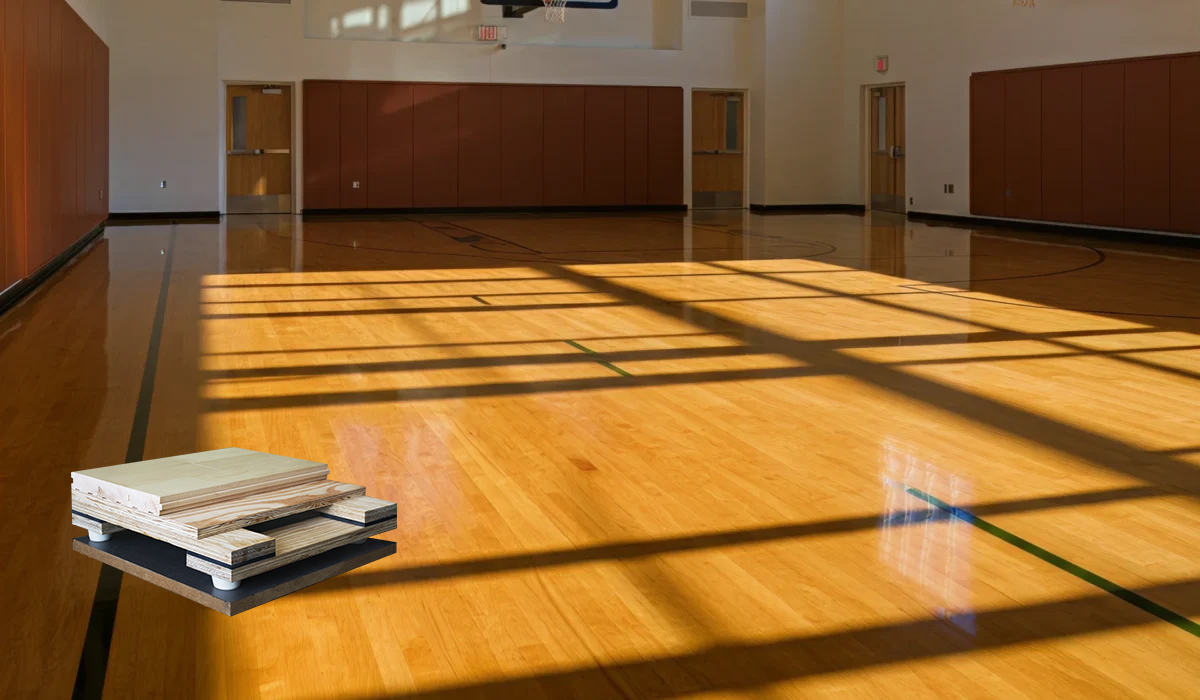
A wood basketball court is a layered assembly. The visible board transfers player loads into a resilient substructure, which influences shock absorption, vertical deformation, ball response and uniformity. Two courts using the same surface species can feel different if their pad spacing, sleepers, panel construction or support conditions differ.
When reviewing a quotation, ask for the complete section drawing. It should identify board construction, thickness, finish, fastening or connection method, vapor protection, resilient elements and subfloor requirements. Performance reports should match that construction rather than a similar product family.
Maple Basketball Flooring
Hard maple is widely associated with basketball and multipurpose gymnasiums. Its light color provides strong visual contrast for game lines and graphics. Industry organizations such as MFMA publish technical guidance, grading information, specification resources and care recommendations for maple athletic floors.
Maple is not maintenance-free. It is a natural material that responds to moisture and environmental change. The building must manage humidity, water entry and cleaning. The finish also requires scheduled inspection and renewal. When these conditions are controlled, a properly designed maple system can be repaired and refinished over a long service life.
- Traditional professional-court appearance
- Light tone for line and logo contrast
- Established grading and specification resources
- Refinishing and board-repair potential
- Requires environmental and maintenance discipline
Birch Basketball Flooring
Birch can offer a clean natural appearance with grain and color that differ from maple. Depending on source, grade and construction, it may provide a commercially attractive option for schools, training centers and multipurpose venues. Buyers should avoid assuming that species name alone predicts performance.
Review hardness, board grading, moisture control, machining consistency, finish system and supporting construction. A well-designed birch system can be more suitable than a poorly specified maple floor. The decision should be based on documented system performance and project conditions.
Engineered and Multi-Layer Wood Systems
Engineered wood uses multiple layers arranged to reduce directional movement compared with a single solid board. This can improve dimensional stability and manufacturing consistency, particularly where humidity varies. The visible wear layer may use a selected wood species while structural layers contribute stability.
The term engineered does not guarantee quality. Compare total thickness, wear-layer thickness, core construction, bonding, machining, finish, support spacing and repair method. Ask whether individual boards or panels can be replaced and how many refinishing cycles the wear layer can support.
| Option | Typical Strength | Main Risk | Best-Fit Projects |
| Maple | Established athletic-floor tradition and light appearance | Moisture and maintenance sensitivity | Professional courts, premium schools, arenas |
| Birch | Alternative appearance and project-value balance | Quality varies by source and grade | Schools, clubs, multipurpose halls |
| Engineered wood | Improved dimensional stability and efficient construction | Wear layer and bonding must be verified | Variable climates, fast-build projects, multi-layer systems |
Single-Keel, Double-Keel and Panel Systems
Wood species cannot compensate for an unsuitable substructure. Single-keel systems may reduce build height and material while providing an elastic response for many facilities. Double-keel systems can offer additional load distribution and system depth where the design requires it. Portable panel systems prioritize rapid assembly, dismantling, storage and repeated alignment.
Compare pad layout, support spacing, load distribution, finished height and transition details. Retractable seating, stages, maintenance equipment and movable goals can create loads that are very different from athletes. These must be checked during design.
Moisture, Climate and Building Operation
Moisture is one of the main risks for wood sports flooring. Sources include the concrete slab, exterior water, cleaning, roof leaks and uncontrolled indoor humidity. A successful project combines slab testing, vapor management, perimeter expansion, drainage where relevant and an operating plan for the building.
In humid or seasonally unstable environments, engineered or bio-based systems may be considered when their tested construction and project suitability are documented. This is not a reason to ignore moisture; every system still needs a dry, stable and properly prepared base.
Performance, Finish and Lifecycle Cost
The floor should be assessed through measurable properties such as shock absorption, deformation, ball behavior, slip characteristics and uniformity, using the project standard where applicable. The finish affects traction, appearance, cleaning and line marking. A glossy court is not automatically a high-performing court.
Lifecycle cost includes environmental control, cleaning, finish renewal, board repair, downtime and event protection. Solid wood may justify a higher initial cost when the venue can maintain and refinish it. Engineered systems may reduce movement and installation complexity, but the buyer must understand the repair and wear-layer limits.
Wood Basketball Flooring Selection Checklist
- Define competition level and primary sports.
- Request the complete system cross-section.
- Verify wood species, grade and board construction.
- Check test reports for the quoted system.
- Survey slab moisture and indoor climate control.
- Compare single-keel, double-keel and portable needs.
- Confirm finish, line marking and maintenance method.
- Review rolling loads and event protection.
- Ask about board replacement and refinishing limits.
- Calculate lifecycle cost and planned downtime.
Frequently Asked Questions
Is maple always better than birch?
No. Maple has strong industry recognition, but the correct choice depends on grade, system construction, performance, climate, maintenance and budget.
Is engineered wood real wood?
Yes, it can use a genuine wood wear layer over multiple structural layers. Buyers should verify the layer construction and repair limits.
Can hardwood basketball flooring be used in humid climates?
It can be used when moisture, slab conditions and indoor humidity are properly managed. More dimensionally stable constructions may reduce risk but do not replace moisture control.
What is the difference between single-keel and double-keel systems?
They use different support arrangements and build heights. The effect on load distribution and performance must be evaluated as a complete system.
How often must a wood court be refinished?
There is no universal interval. Use level, cleaning, finish type, events and maintenance quality determine the schedule.
Conclusion
Maple, birch and engineered wood should be compared as complete basketball flooring systems rather than isolated surface boards. Species, substructure, moisture control, finish and maintenance work together.
A transparent system drawing and matching performance documentation are more useful than a species claim alone. Select the option that fits the venue’s climate, schedule, competition level and lifecycle plan.
| Plan Your Sports Flooring Project with VMKONPlanning a new court, renovation or portable venue? Send VMKON the project country, sport, court dimensions, site or subfloor photos, expected usage, certification needs and target schedule. We will recommend a suitable system and prepare a project-based quotation.Website | WhatsApp +1 314 398 6832 | Request a Quote |
Recommended Internal Links
- Explore VMKON maple hardwood double-keel flooring
- View the multi-layer hardwood 18T system
- Compare Macwood bio-based sports flooring
- Request a wood-system recommendation
Reference Sources for Editorial Review
- Maple Flooring Manufacturers Association
- MFMA – Select a Floor
- MFMA Performance Based Floor System
- ASTM F2772-24 – Indoor Sports Floor Systems
- EN 14904:2006 – Surfaces for Sports Areas
- VMKON Sports Flooring Systems
Editorial note: Verify all project-specific performance, certification, legal, structural, fire, accessibility and installation requirements with qualified local professionals before publication or procurement.